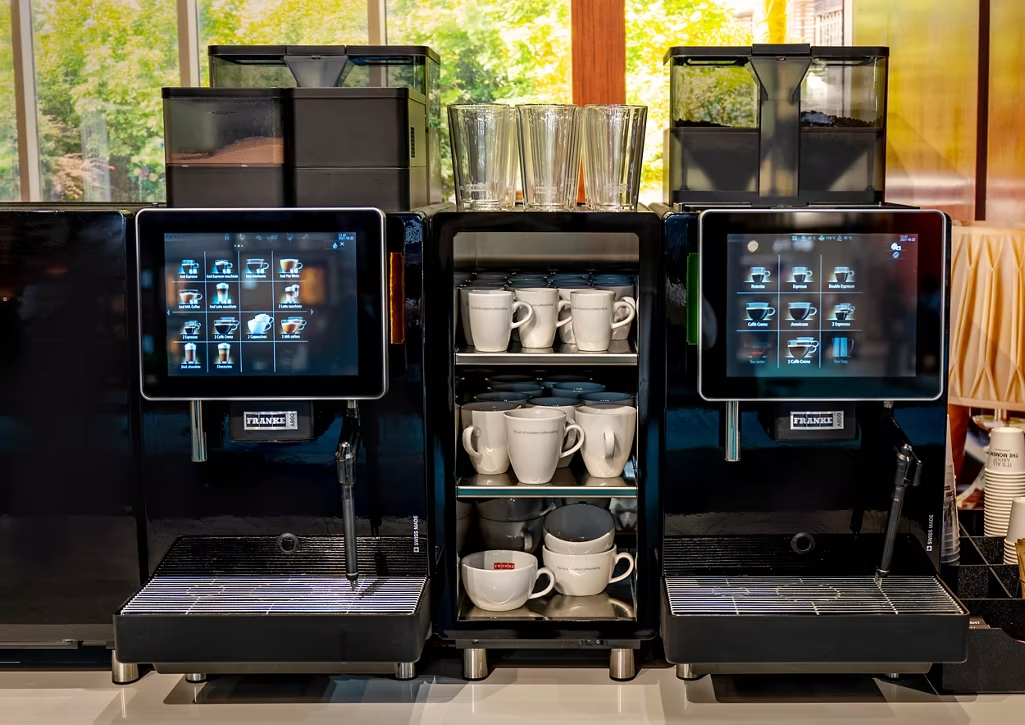
The Franke A400, A600 and A800 are designed for different levels of commercial coffee demand. The A400 is a strong choice where up to around 100 drinks per day and a compact professional setup are enough. The A600 increases capacity and flexibility for busier served or self-service environments, with CoffeeLady’s currently listed version rated at 150 drinks per day. The A800 moves into high-volume use with up to 250 drinks per day, three boilers, up to three grinders and a larger 10.4-inch display.
The best choice is not automatically the largest machine. The A400 can be the better investment when demand is moderate, the A600 provides a useful middle ground for busier businesses, and the A800 earns its higher cost where sustained volume and peak-time performance genuinely require its extra capacity.
Check which A600 or A800 generation you are comparing
Franke’s A-Line has evolved, so businesses comparing quotations should check the exact model generation and configuration being offered.
CoffeeLady currently lists the Classic A600 configuration with an 8-inch touchscreen, up to two grinders and a recommended daily output of 150 drinks. Franke UK also now offers a newer A600 generation with a 10.4-inch touchscreen, capacity of up to 200 cups per day and up to three grinders. Those are meaningful differences, especially when comparing quotations from different suppliers.
The same principle applies across the A-Line. Machine generation, milk system, grinder count, powder options, cooling unit, cleaning system and electrical configuration can all affect the final specification. Model names alone are therefore not enough to compare two proposals properly.
The comparisons below use the A400, A600 and A800 configurations currently listed by CoffeeLady, with the relevant manufacturer information used to clarify where different generations exist.
Franke A400, A600 and A800 compared
Feature
Franke A400
Franke A600
Franke A800
Best fit
Moderate commercial demand needing a compact professional machine
Busier served or self-service locations needing more capacity and flexibility
High-volume locations where peak-time output is a major requirement
Current listed daily output
100 drinks
150 drinks
250 drinks
Grinders
Up to 2
Up to 2 on current CoffeeLady configuration
Up to 3
Display
8-inch touchscreen
8-inch touchscreen on current CoffeeLady configuration
10.4-inch touchscreen
Milk capability
FoamMaster or milk pump system depending on configuration
FoamMaster, DualMilk and alternative-milk options depending on configuration
FoamMaster with higher-volume milk options and DualMilk capability
Cleaning
CleanMaster or EasyClean depending on configuration
CleanMaster or EasyClean depending on configuration
EasyClean automatic cleaning on current listed specification
Current listed price ex VAT
From £7,265.48
From £8,347.50
From £12,882.45
Current lease-from figure
£37.43 per week
£42.53 per week
£70.56 per week
Main reason to step up
A400 capacity is becoming restrictive
Higher sustained output or greater menu flexibility is needed
Peak demand requires substantially more output and simultaneous preparation
Main reason not to step up
A400 already handles demand comfortably
A400 still provides enough capacity and functionality
Demand does not justify the extra purchase cost and installation requirements
The most important difference is not simply price. Each machine belongs to a different level of commercial use, and the right model is the one that can handle normal and peak demand without leaving the business paying for capacity it is unlikely to use.
Franke A400 for moderate commercial demand
The Franke A400 is the most compact and least expensive of the three machines compared here, but it is still a serious commercial bean to cup system.
Franke rates the A400 for up to 100 cups per day. It uses an 8-inch colour touchscreen and can be configured with up to two precision grinders. Different brewing-unit options allow the machine to be specified around espresso-led menus or higher-volume brewed coffee requirements, depending on the business.
Its strongest use case is a site that wants a professional automatic coffee offer without needing the sustained capacity of the A600 or A800. That can include offices, reception areas, showrooms, hotels with moderate coffee demand, smaller hospitality environments and other locations where drinks are made regularly but the machine is not subjected to heavy rush periods throughout the day.
The A400 can also be configured with Franke’s FoamMaster technology, allowing it to produce hot and cold milk and milk foam with controlled consistency. That means a business does not need to move to the A600 simply because cappuccino, latte or flat white is part of the menu.
Cleaning configuration also matters. Depending on the specification, the A400 can use Franke’s CleanMaster or EasyClean systems. The exact cleaning arrangement should be confirmed at quotation stage because it affects the daily staff routine as well as the machine configuration.
For a business comfortably within the 100-drink category, the A400 can provide much of the core Franke experience without the additional cost of the larger machines.
When the A400 is the better choice
The A400 is particularly strong when daily demand is predictable and comfortably below its recommended capacity. If a business serves 50 or 60 drinks through the day without sustained queues, there may be little operational benefit in moving immediately to the A600.
Its two-grinder capability is also enough for many businesses. A common setup is one main coffee bean and one decaffeinated option, although different roast or blend combinations can also be used. If two bean choices satisfy the menu, the third grinder available on the A800 has no practical value.
Space can also favour the A400. The core machine is approximately 340mm wide, although the complete installation becomes wider once refrigeration and other add-ons are included. In environments where the coffee point has limited counter space, that compact core format is useful.
A larger model should therefore solve a specific limitation rather than simply appear more future-proof. If the A400 comfortably covers current demand and realistic growth, it remains a strong commercial choice.
When the A400 starts to become restrictive
The A400 becomes less suitable when normal use starts to sit too close to its intended workload or when peak-time demand creates recurring queues.
A business may serve fewer than 100 drinks during the entire day and still need more capacity if a large proportion of those drinks are ordered within the same breakfast, lunch or meeting period. The daily figure tells only part of the story.
Milk-heavy menus can make this more noticeable because repeated cappuccinos, lattes and flat whites create a different workflow from repeated espressos or americanos. If the machine is frequently under pressure during the busiest periods, moving to the A600 may provide a more comfortable operating margin.
The A400 should also be reconsidered when the business needs greater menu flexibility or expects demand to grow materially. The aim is not to use every last drink of a machine’s theoretical daily capacity before upgrading. Commercial equipment performs best when its normal workload sits comfortably within what it was designed to handle.
Franke A600 for greater flexibility and sustained use
The Franke A600 sits between the A400 and A800 and is likely to be the most balanced choice for many busier commercial locations.
CoffeeLady’s currently listed A600 configuration is rated at 150 drinks per day and uses an 8-inch touchscreen with up to two grinders. It supports Franke’s FoamMaster milk technology, DualMilk options, flavour dosing and powder systems depending on the chosen specification.
That additional capacity makes the A600 more comfortable where the A400 would begin to look marginal. It can suit businesses with heavier all-day use, more concentrated rush periods or a more varied drink menu without requiring the substantial jump to the A800.
The A600 is also designed for both served and self-service environments. That gives it useful flexibility across workplace coffee points, hotels, restaurants, cafés, lounges and other commercial locations where different users may operate the same machine.
Its ability to combine coffee, milk, flavour and powder options means the A600 can support a more varied menu than businesses may initially expect from a fully automatic system. The value of those options depends on the actual offer, however. There is little benefit in adding syrups, chocolate or multiple milk choices unless customers or staff are likely to use them.
A400 versus A600
For many businesses, this is the most relevant comparison in the range.
CoffeeLady currently lists the A400 from £7,265.48 ex VAT and the A600 from £8,347.50 ex VAT. The corresponding lease-from figures are £37.43 and £42.53 per week.
The gap is relatively modest compared with the later move from A600 to A800, which can make the A600 tempting even when the A400 could already handle the requirement.
The extra spend becomes worthwhile when the additional capacity provides useful operating headroom. A business moving towards 100 drinks per day, particularly where demand is concentrated into busy periods, can benefit from choosing a machine designed for a heavier workload rather than starting too close to the A400’s upper range.
The A600 can also make more sense where the drinks menu is broader or where the machine has to serve both staff and customers in a busy self-service setting.
Where demand remains moderate, the A400 should not be dismissed as the lesser machine. Its milk capability, touchscreen, grinder options and professional brewing platform already cover a wide range of commercial needs.
The A600 earns its place when its extra capacity or configuration flexibility will actually be used.
Franke A600 milk and drink flexibility
Milk configuration is often one of the reasons businesses move towards the A600.
Franke’s FoamMaster system can produce different milk and foam consistencies for automatic drinks, while DualMilk and alternative-milk options can be incorporated depending on the selected configuration. This can be particularly useful where the menu includes both dairy and plant-based alternatives.
The cooling unit should be considered as part of the same decision. A site producing occasional milk drinks has different refrigeration requirements from a location serving repeated cappuccinos and lattes throughout a breakfast or lunch period.
Flavour and powder options can expand the menu further. The A600 can support automatic syrup dosing and powder ingredients such as chocolate, allowing the machine to cover drinks beyond straightforward espresso and milk combinations.
These additions should be selected around genuine demand. A relatively simple coffee menu does not become better merely because every optional component has been added.
Franke A800 for high-volume service
The Franke A800 is the high-volume machine in this comparison.
CoffeeLady currently lists it for up to 250 drinks per day. The current specification includes a 10.4-inch display, three separate high-performance boilers and support for up to three precision grinders.
The three-boiler system is one of the most important differences between the A800 and the smaller machines. It allows coffee, milk and hot water preparation to be handled with greater independence, which becomes increasingly valuable when several drinks are being prepared during a busy service period.
This is what makes the A800 particularly suited to high-volume hotel breakfast areas, large workplace coffee points, busy self-service locations and other environments where a queue can build quickly.
The third grinder option adds another layer of flexibility. A business could use separate grinders for a house bean, decaf and an additional roast or blend if that level of choice supports the menu.
The larger touchscreen also becomes more useful when the machine carries an extensive self-service menu. More screen space can make navigation clearer where users are selecting between different coffees, milk choices, flavours or other options.
The A800 should therefore be viewed as a machine built around high throughput and complex service, not simply as the premium version of the A600.
When the A800 justifies its higher cost
CoffeeLady currently lists the A800 from £12,882.45 ex VAT, compared with £8,347.50 for the A600. Its lease-from figure is £70.56 per week, compared with £42.53 for the A600.
That is a meaningful step in cost, so the operational benefit should also be meaningful.
The first reason to move to the A800 is daily capacity. The current listed configuration increases recommended output from 150 drinks on the A600 to 250 drinks.
The second is performance during concentrated demand. Three independent boilers allow the machine to cope more effectively when coffee, milk and hot water are required at the same time.
The third is menu flexibility. Up to three grinders can support an additional bean choice, while the larger display gives more room for a complex drinks menu.
These advantages can be valuable in a busy operation, but they do not automatically improve a site that only needs 80 or 100 drinks throughout a normal day. The A800 earns its additional cost when its extra capability solves an existing or clearly foreseeable operational problem.
A600 versus A800
The difference between the A600 and A800 becomes clearest when volume and peak demand are considered together.
A business serving 100 to 120 drinks gradually across the day may find the A600 entirely comfortable. Even a higher total can be manageable where demand is spread evenly and the drinks menu remains relatively simple.
The A800 becomes more compelling when a similar or higher number of drinks has to be produced within short service windows. Hotel breakfast periods are a good example. A machine may need to produce repeated milk drinks, coffee and hot water while several customers are waiting.
The A800’s three-boiler architecture is designed for that type of workload.
Menu complexity can reinforce the decision. If the operation wants three bean choices, a large milk-based menu, chocolate, flavours and extensive self-service presentation, the A800 provides more room to build that offer.
The A600 remains the stronger value proposition for many busy businesses. The A800 becomes the stronger operational choice when the workload would regularly push the A600 close to the limit.
A400 versus A800
The A400 and A800 sit far enough apart that a business genuinely undecided between the two should examine its requirement carefully before choosing.
The A400 is rated at 100 drinks per day and supports up to two grinders, automatic milk options and a professional touchscreen experience.
The A800 increases capacity to 250 drinks, adds a three-boiler system, supports up to three grinders and uses a larger 10.4-inch display.
Those differences are substantial. They also come with a substantial difference in cost.
A business that needs an A800 should normally have clear reasons for doing so. High daily volume, intense peak periods, larger milk demand or greater menu complexity are examples. If those pressures are absent, the A400 or A600 is likely to provide a more proportionate solution.
Which machine is better for self-service
All three machines can support self-service use, but the intensity of that use should guide the decision.
The A400 can work very well where customers, visitors or staff need an intuitive automatic machine but the daily workload remains moderate. Its 8-inch touchscreen provides enough room for a clear customised drinks menu.
The A600 is better suited to a busier self-service location, particularly where a wider drinks selection or stronger daily capacity is required.
The A800 becomes more attractive when self-service also means high traffic. Its larger display, higher output and three-boiler system can make a meaningful difference when many users are ordering different drinks during the same busy period.
The fact that a machine can operate in self-service mode is therefore only the starting point. The number of users, menu complexity and intensity of peak periods are more important.
Which machine is better for served environments
A served environment changes the emphasis because trained or semi-trained staff may be operating the machine rather than customers.
The A400 is a strong option where automation is mainly being used to provide consistent drinks without relying on barista skills. Staff can select the required drink and allow the machine to handle the programmed preparation.
The A600 offers more flexibility when the menu becomes broader or demand becomes heavier. Milk options, flavour dosing and other configurations can help a venue expand the menu while retaining automatic consistency.
The A800 becomes more valuable where speed during busy service is critical. Its ability to handle coffee, milk and hot water with greater independence is particularly useful when staff are preparing several drinks close together.
The right machine depends on whether automation is being used mainly for consistency, greater menu breadth or high-volume service.
How grinder count affects the menu
Grinder count matters when a business wants more than one type of coffee bean available at the same time.
The A400 can support up to two grinders, which is enough for common combinations such as a main house blend and decaf. The CoffeeLady A600 configuration can also support up to two precision grinders.
The A800 can support up to three grinders. This may be useful where the business wants a house blend, decaf and a second speciality roast, or another combination of three distinct beans.
The third grinder should not be treated as automatically better. If the business only intends to serve one main bean and decaf, two grinders already satisfy the requirement.
The A800’s extra flexibility becomes worthwhile when three bean choices form a genuine part of the menu.
Milk demand can change the recommendation
Milk-based drinks place different demands on an automatic machine from repeated black coffee.
All three machines can be configured to support commercial milk menus, so the presence of cappuccino or flat white alone does not mean the business needs an A600 or A800.
The recommendation changes when milk drinks combine with high throughput.
A location producing repeated lattes and cappuccinos during a concentrated breakfast or lunch period benefits more from the A800’s three-boiler design than a site making the same drinks gradually throughout the day.
Cooling capacity should also match demand. A small milk fridge can be perfectly adequate for moderate use, while a busy operation may need a larger refrigeration solution to avoid constant replenishment.
The relevant question is therefore not simply whether milk drinks are required, but how many need to be produced and how quickly.
Touchscreen size and menu complexity
The A400 and the Classic A600 currently listed by CoffeeLady use 8-inch touchscreens. The A800 uses a 10.4-inch display.
For a straightforward drinks menu, the smaller screen is unlikely to create a major disadvantage. An 8-inch display still provides a clear interface for drink selection and customisable menu presentation.
The larger A800 screen becomes more useful as the menu grows. A site offering several bean choices, milk options, flavours and speciality drinks can use the additional screen space to make self-service navigation clearer.
Display size should therefore be considered alongside menu complexity. It is useful functionality, but not a reason on its own to move from an A600 to an A800.
Installation requirements
Commercial coffee machines need to be assessed as complete installations rather than just countertop appliances.
The A400 and A600 require suitable electrical supply for the machine and any connected refrigeration. CoffeeLady’s current product information shows standard 220 to 240V configurations, with precise amperage depending on the build.
The A800 has higher performance requirements and can be supplied in different electrical configurations, including three-phase options. The proposed site should therefore be checked before the final machine specification is agreed.
Mains water, filtration, drainage, milk refrigeration, waste management and service access should also be considered. A machine may physically fit on a counter while the complete installation does not.
This is particularly important with the A800 because a high-volume configuration can involve refrigeration, flavour systems, cup storage and other components around the core machine.
A proper site assessment before ordering helps prevent the machine choice from being constrained later by power, water or available space.
Franke A400, A600 and A800 prices in the UK
CoffeeLady’s current listed starting prices are:
The Franke A400 starts from £7,265.48 ex VAT, with leasing advertised from £37.43 per week.
The Franke A600 starts from £8,347.50 ex VAT, with leasing advertised from £42.53 per week.
The Franke A800 starts from £12,882.45 ex VAT, with leasing advertised from £70.56 per week.
These figures provide a useful starting point, but the final installed cost depends on the machine configuration. Milk refrigeration, additional grinders, powder systems, flavour stations, filtration, electrical work, accessories and other requirements can change the total.
Finance should also be compared carefully. A weekly lease figure needs to be considered alongside the finance period, advance payment, end-of-term arrangement and any services included in the agreement.
Machine finance and machine servicing should not automatically be treated as the same thing. The quotation should make clear whether maintenance, parts, call-outs or other support are included separately.
Does the A600 offer the best value
For many businesses, the A600 will be the most attractive middle ground.
The price increase from A400 to A600 is relatively small compared with the jump to A800. In return, the current CoffeeLady configuration increases recommended daily capacity from 100 to 150 drinks and provides a platform intended for busier commercial use.
That does not automatically make the A600 better value.
If a business is unlikely to exceed 60 or 70 drinks per day, the A400 may already provide everything required. In that case, spending more for additional capacity may produce little return.
The A600 becomes especially attractive where the business is close enough to the A400’s upper range that additional headroom has clear value. It can also be the better choice where menu or self-service requirements are likely to expand.
Value comes from using the extra capability, not simply acquiring it.
When the A800 offers better value
The A800 can represent better value despite its substantially higher purchase price when downtime, queues or slow peak-time service would have a meaningful commercial impact.
A busy hotel breakfast room is a good example. If guests are waiting because the machine cannot process coffee and milk drinks quickly enough, the additional capacity and boiler performance can directly improve the service experience.
The same principle applies in a large workplace or hospitality location where one machine serves a high number of users within short periods.
In those environments, the relevant comparison is not simply £8,347.50 versus £12,882.45. It is whether the smaller machine can deliver the required service comfortably every day.
Where the answer is yes, the A600 remains better value. Where the answer is no, the A800’s additional cost can become commercially justified.
Franke A400, A600 or A800 for hotels
Hotels need to consider where and when the coffee machine will be used.
The A400 can suit a smaller breakfast area, lounge or meeting facility where daily demand is moderate. It offers a broad automatic drinks menu without requiring a high-volume installation.
The A600 becomes stronger where breakfast demand is higher or the machine continues working through the day in lounges, restaurants or meeting spaces. Its additional capacity provides more room for a busier mixed-use operation.
The A800 is more appropriate where breakfast creates an intense service period. A large number of guests may arrive within a narrow window and request milk drinks, coffee and hot water at the same time. The machine’s three-boiler system and greater overall capacity are designed for that type of pressure.
A hotel should therefore size the machine around the busiest realistic service period rather than simply dividing the daily total across the whole day.
Franke A400, A600 or A800 for workplaces
Workplace demand is often less predictable than it first appears.
Coffee use may be relatively steady during much of the day but rise quickly when people arrive in the morning, finish meetings or take lunch breaks. Hybrid working can also make some days much busier than others.
The A400 suits workplaces where normal use stays comfortably within the 100-drink class and peak periods remain manageable.
The A600 provides more capacity for busier offices, shared coffee points and environments where one machine serves both staff and visitors.
The A800 makes more sense where the coffee point is supporting genuinely high use and queues during busy periods would create a recurring problem.
Employee numbers alone should not determine the machine. Actual attendance, drinks per person, visitor demand and peak-time behaviour provide a much more useful picture.
Franke A400, A600 or A800 for hospitality
Restaurants, cafés and other hospitality businesses should consider whether coffee is a core part of the offer or a supporting service.
A restaurant serving coffee mainly after meals may be well suited to the A400 even if the venue itself is busy. The machine only needs to handle the volume of coffee actually ordered.
The A600 becomes more attractive where coffee is served throughout the day and the menu includes a broader range of milk drinks, flavours or other options.
The A800 is designed for locations where automatic coffee service becomes a high-volume part of the operation and consistent speed during busy periods matters.
A larger venue does not automatically need a larger machine. The coffee workload itself should determine the model.
When another Franke model may make more sense
The A400, A600 and A800 cover a broad range of commercial requirements, but they are not the only options in Franke’s portfolio.
Where demand is clearly below the A400 class, the A300 may provide a more proportionate route into the A-Line.
At the opposite end, particularly high-volume or highly complex operations may need to consider larger Franke platforms or multiple machines rather than expecting one A800 to support every service point.
A traditional or semi-automatic machine may also be a better fit where trained baristas and manual drink preparation are central to the experience.
The A-Line is strongest where businesses value automation, repeatability, straightforward self-service or consistent staff-operated drinks.
Which one would we choose
For commercial demand comfortably within the 100-drink class, we would begin with the A400. It already offers automatic milk capability, grinder flexibility and a professional interface without paying for output the business may never need.
Where demand sits above that level or the operation needs additional room for busy service periods, the A600 is the strongest middle-ground choice. Its current 150-drink positioning gives the business more flexibility without moving directly into A800 pricing.
Where daily volume and peak-time pressure are genuinely high, the A800 earns its premium through 250-drink capacity, three-boiler performance, up to three grinders and a larger display.
The best Franke machine is therefore the smallest model that can comfortably support normal demand, peak demand and realistic growth without spending every working day close to its limit.
Final recommendation
The A400, A600 and A800 should be viewed as three different levels of commercial performance rather than a simple good, better and best hierarchy.
The A400 is a highly capable professional machine for moderate commercial demand. It is compact, supports automatic milk systems and can be configured with up to two grinders, making it suitable for a wide range of businesses that do not need sustained high-volume output.
The A600 provides a useful increase in capacity and flexibility. For businesses where the A400 is beginning to look restrictive, its 150-drink positioning and wider commercial scope can justify the relatively modest increase in current listed price.
The A800 is designed for sites where volume and peak-time performance are central to the buying decision. Its 250-drink capacity, three boilers, larger display and additional grinder option make sense when high throughput is a daily requirement rather than an occasional event.
Choosing the right model means looking at actual demand, the busiest service periods, milk use, menu complexity and the way the machine will be operated. When those factors are clear, the difference between the three machines becomes much easier to justify.
FAQs
What is the main difference between the Franke A400, A600 and A800?
The main difference is the level of commercial demand each machine is designed to support. CoffeeLady currently lists the A400 at 100 drinks per day, the A600 at 150 and the A800 at 250. The A800 also adds a three-boiler system, support for up to three grinders and a larger 10.4-inch display for high-volume service.
Is the Franke A600 worth the extra cost over the A400?
The A600 is worth the additional cost where the A400’s 100-drink capacity would leave too little operating headroom or where the business needs a more flexible platform for busier served or self-service use. If normal demand is comfortably below the A400’s capacity, the A400 may remain the stronger-value choice.
How much does a Franke A800 cost in the UK?
CoffeeLady currently lists the Franke A800 from £12,882.45 ex VAT, with leasing advertised from £70.56 per week. The final project cost depends on the exact machine configuration, milk refrigeration, grinders, flavour or powder options, filtration, electrical requirements and installation.
Ready to compare the right Franke machine
If you know your normal daily drink volume, what happens during the busiest service period and how broad the drinks menu needs to be, CoffeeLady can compare the A400, A600 and A800 against the actual site requirement.
The final recommendation can then account for machine configuration, milk refrigeration, power, water, installation and current purchase or finance pricing before the equipment is specified.
Not sure what this means for your setup?
Talk it through with the Coffee Lady team. Free advice, honest recommendations and UK-wide installation and servicing for workplace coffee.
Why office coffee machine costs vary Office coffee machine costs vary because workplaces have different levels of demand. A small office may only need a compact machine that…
What makes a coffee maker suitable for a small office A good small office coffee maker should be compact, reliable, easy to clean, and simple to use without…
Start with your workplace, not the machine Many businesses start by looking at brands or machine styles before they have properly defined what they need. In reality, the…
To provide the best experiences, we use technologies like cookies to store and/or access device information. Consenting to these technologies will allow us to process data such as browsing behavior or unique IDs on this site. Not consenting or withdrawing consent, may adversely affect certain features and functions.
Functional
Always active
The technical storage or access is strictly necessary for the legitimate purpose of enabling the use of a specific service explicitly requested by the subscriber or user, or for the sole purpose of carrying out the transmission of a communication over an electronic communications network.
Preferences
The technical storage or access is necessary for the legitimate purpose of storing preferences that are not requested by the subscriber or user.
Statistics
The technical storage or access that is used exclusively for statistical purposes.The technical storage or access that is used exclusively for anonymous statistical purposes. Without a subpoena, voluntary compliance on the part of your Internet Service Provider, or additional records from a third party, information stored or retrieved for this purpose alone cannot usually be used to identify you.
Marketing
The technical storage or access is required to create user profiles to send advertising, or to track the user on a website or across several websites for similar marketing purposes.